Every major residential panel sold in Miami-Dade, decoded — heat performance, hurricane ratings, degradation, warranties. No affiliate links, no quote forms, nobody selling your number. When you're ready, you call an installer yourself.
Sales reps lead with wattage because it's the biggest number. In Miami, it's not even in the top three things that matter. Learn these six and no spec sheet will ever snow you again.
Panels lose output as they heat up — and a Miami rooftop in August runs far above the 25°C lab standard. This number is how much production dies per degree. The difference between −0.26 and −0.34 is real money here, every single afternoon, for 25 years. In Miami, this beats raw efficiency.
How much sunlight becomes electricity. Higher efficiency means more power per square foot — decisive on small or complex roofs, less critical if you have acres of clean south-facing shingle. Top of the 2026 market sits around 24%.
How fast the panel fades. At 0.25%/year a panel still makes ~92% of its day-one power at year 25; at 0.55% it's down near 85%. Over a system's life that gap compounds into thousands of kilowatt-hours.
Output per panel under lab conditions. Useful for counting how many panels your roof needs — but a bigger panel is often just a physically bigger panel. Never compare wattage without comparing size and efficiency alongside it.
Two different promises: the product warranty covers the physical panel failing; the performance warranty guarantees output (e.g., "≥90% at year 25"). Premium makers now back both for 25–40 years. A long warranty from a maker that might not exist in year 12 is worth less — brand bankability is part of the spec.
The structural rating for wind pressure on the mounted panel. Everywhere else this is fine print. In Miami-Dade's high-velocity hurricane zone, it's the law — see below.
A panel that's perfect in Phoenix can be wrong — or illegal to install — in Miami-Dade. These are the local filters every product must pass before brand or price even enters the conversation.
Miami-Dade is a High-Velocity Hurricane Zone with the strictest product approvals in the country. Panels and racking installed here must hold a current Miami-Dade Notice of Acceptance certifying they survive HVHZ wind loads. Ask your installer for the NOA numbers on the exact panel and racking quoted. A legitimate Miami installer produces them instantly; hesitation is your answer.
Lab specs are measured at 25°C. Your roof spends half the year far hotter. A panel with a slightly lower efficiency but a superior temperature coefficient will out-produce a "more efficient" rival across a Miami summer. This is the most common way homeowners here buy the wrong panel for the right-sounding reason.
Salt air corrodes frames, junction boxes, and connectors. Panels certified to IEC 61701 (salt mist corrosion) are tested for exactly this. If your home is within a few miles of the water — which in Miami-Dade is most homes — make it a requirement, not a preference.
These are the names that show up in real Miami quotes in 2026, profiled neutrally. We sell none of them, earn nothing from any of them, and the installers in our directory carry different brands — that independence is the point. "Heat Pick" marks standout hot-climate performers.
A solar install isn't "some panels." A typical 20-panel system is roughly 180–220 discrete components that must be engineered, permitted, mounted, wired, and inspected to Miami-Dade HVHZ code. When you understand the parts list, the crew size, the timeline, and the quote all start making sense — and you negotiate from knowledge.
Each panel is itself ~9 parts: tempered glass, silicon cells, busbars, encapsulant, backsheet or rear glass, frame, junction box, bypass diodes, connectors. 20 panels × 9 ≈ 180 parts before anything else.
A string inverter, or per-panel microinverters/optimizers (one each). Converts DC to the AC your home uses and, in Miami, enables panel-level shutdown for safety code.
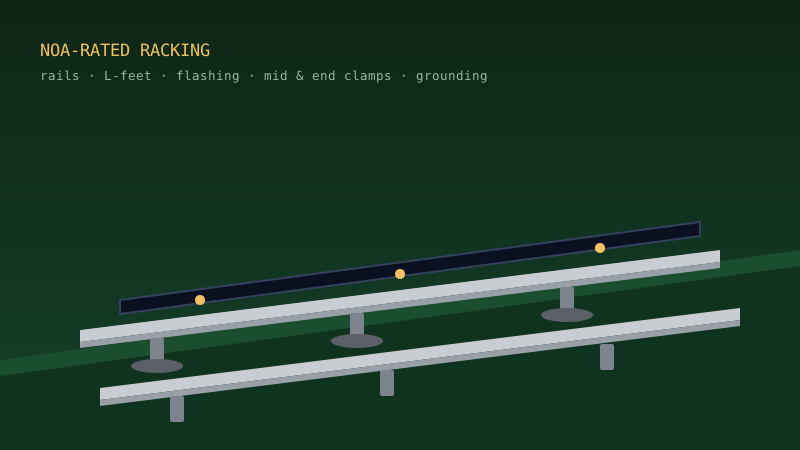
Rails, mid/end clamps, dozens of roof attachments and flashings, grounding hardware — all of which must carry Miami-Dade NOA approval for HVHZ wind loads. This is where install quality lives or dies.
DC/AC wiring, conduit, rapid-shutdown devices, a new breaker or main-panel work, an AC disconnect, production monitoring, and often a utility meter swap with FPL.
So when a quote shows a 4-person crew for 2.5 days: that's mounting ~200 engineered parts to a hurricane-rated standard, running and terminating wiring, coordinating a permit and a city inspection, and a utility interconnection. The panel brand you picked on the stats page is one decision inside a much larger build — which is exactly why installer quality matters as much as panel choice.
Installed residential solar in 2026 runs roughly $2.50–$3.00 per watt before incentives — a 7 kW system landing between $17,500 and $21,000, with Florida's sales tax exemption already keeping ~6% off the equipment.
Below $2.40/W, ask hard questions about panel tier, racking quality, and the workmanship warranty. Above $3.20/W, you should be getting Maxeon-class hardware, a battery, or a complicated roof — otherwise you're funding someone's sales commission.
The panel itself is usually only ~25–30% of the system price. The rest is inverter, racking, labor, permitting, and margin — which is why who installs it matters more than which logo is on the glass.
Ask these on the first call. You'll be quoted differently — better hardware, straighter numbers — because they'll know you can't be sold to, only convinced.
Forces specificity past brand-name hand-waving and confirms HVHZ compliance in one breath.
Separates installers who engineer for Miami from installers who paste Phoenix proposals.
A production guarantee or written estimate is accountable. "Around 90% offset" is not.
The panel maker covers the glass. Who covers the roof penetrations, the wiring, the leak five years from now — and for how long?
The honest comparison post-federal-credit. If they claim a 30% credit on the purchase option, end the call — and see our Rebate Station for why.
Browse Miami-Dade installers in the directory and contact them directly. We don't take a cut, hold your information, or sit in the middle — your call goes straight to their phone.